What happens if a farmer pushes a small layer of dirt to the low side of every acre, so the rain that falls on that acre stays there and soaks down instead of running to the ditch.
Every number on this page comes from a real published page, and each one is listed in the sources at the bottom. Where nobody has measured something, this page says so instead of guessing.




Swipe sideways, use the arrows, or press the left and right arrow keys. Download the carousel as a PDF.
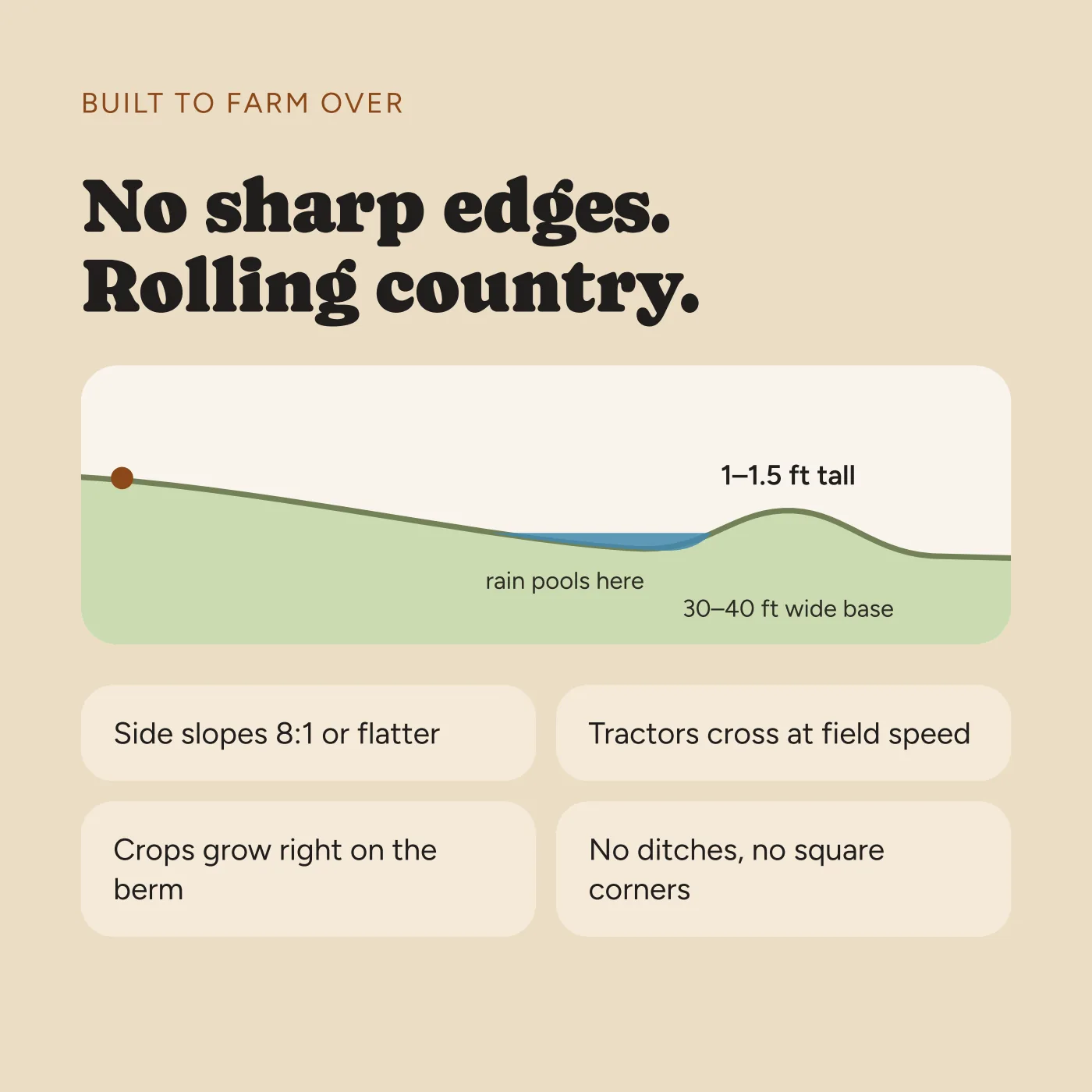
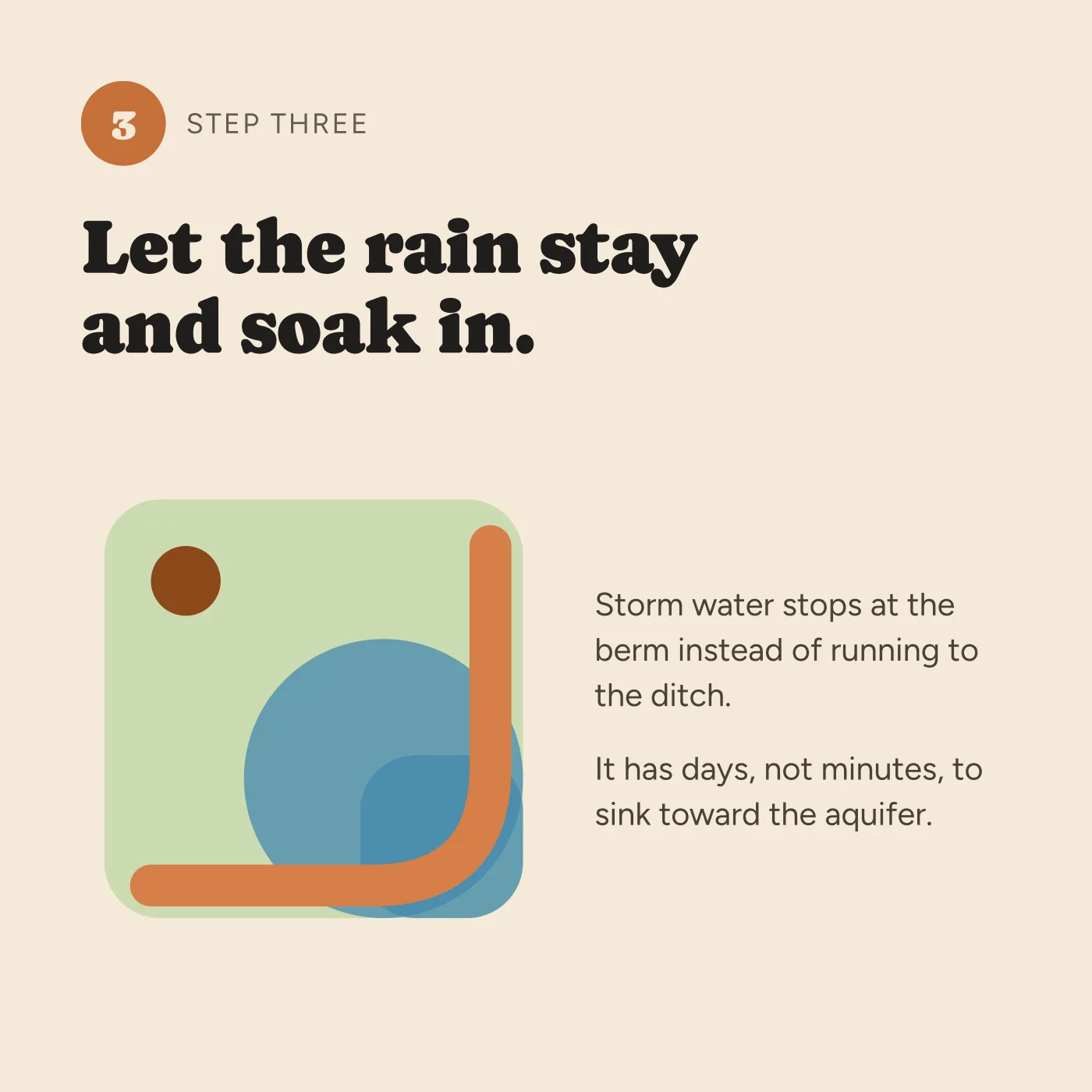
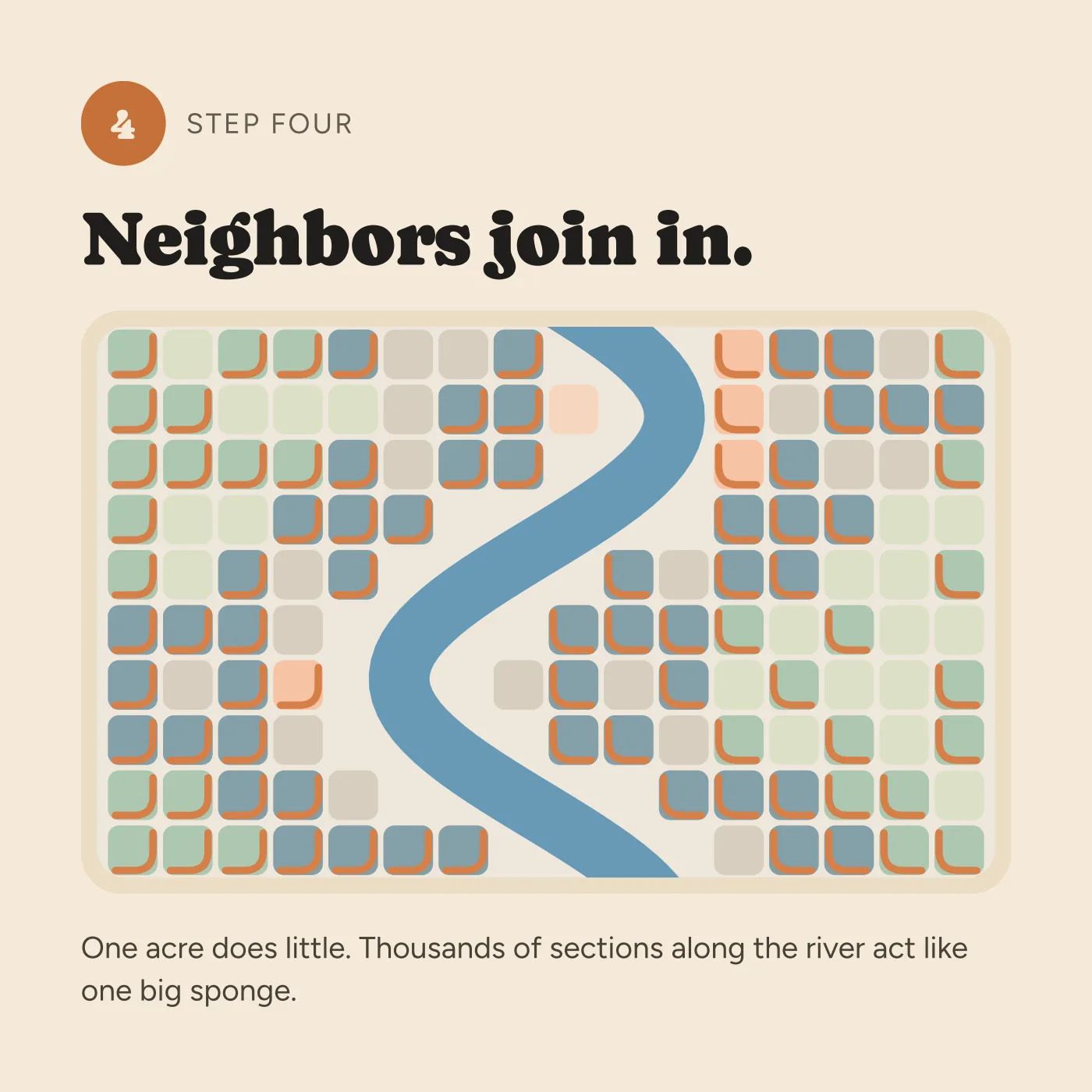
Every field tilts a little, and water always leaves through the low side. If a farmer pushes a low, rounded ridge of soil along that low side — about one to one and a half feet tall, with a base thirty to forty feet wide and sides so gentle a tractor drives straight over them — the rain that falls on that acre stops there instead of running into the ditch. Instead of minutes, the water has days to sink down. Done on one acre it does almost nothing. Done on thousands of acres along a river it behaves like one enormous sponge.
One inch of rain on one acre is 27,154 gallons of water, which is a little over one twelfth of an acre-foot. That figure is fixed arithmetic, not an estimate: an acre is 43,560 square feet, and an inch of water over it is 3,630 cubic feet.
So a basin that holds back one inch across a 640-acre section is holding roughly 17.4 million gallons, or about 53 acre-feet, from a single storm. That is the honest size of the idea. What matters next is how much of it actually goes down rather than back up into the air.
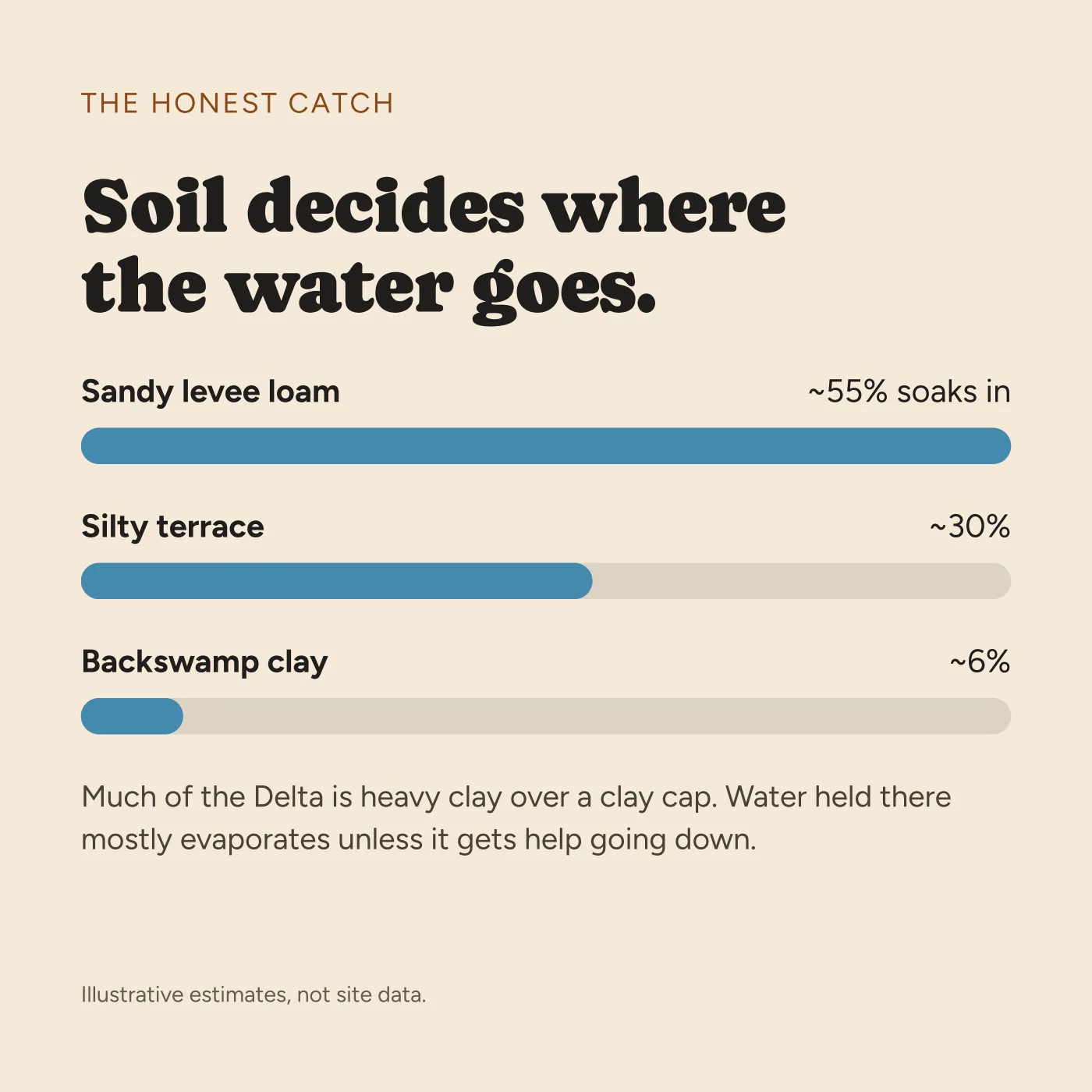
This is the part that decides whether the whole idea works, and the carousel is right to call it the honest catch.
Soil decides. On sandy and silty ground a large share of ponded water moves down. On heavy clay, very little does, and most of what is held simply evaporates unless something helps it get below the clay. A long-running no-till field can take in up to four inches an hour, and a no-till field that has also grown cover crops for a few years can reach six to eight inches an hour — so the soil a farm already has is not fixed, and is the cheapest thing to change.
The strongest real-world evidence that ponding recharges an aquifer comes from playas, the shallow natural basins scattered across the High Plains. Recharge under a playa runs ten to a thousand times higher than under the land around it, and an unaltered playa can put more than three inches a year into the aquifer. Playas are credited with the large majority of the water that reaches the Ogallala in the southern High Plains. A berm basin is, deliberately, a playa somebody built.
Here is the honest arithmetic, and the honest limit of it.
The Ogallala has been falling by roughly half a foot a year on average over the last thirty years, and by one to three feet a year in hard-pumped areas. Natural recharge across much of it is well under an inch a year — as little as a fortieth of an inch in parts of Texas and New Mexico. Against that, a built basin that delivered even one extra inch a year would be a large proportional change to recharge, while still being small against pumping.
On sandy and silty ground, where water really moves down, twenty years of holding an extra inch or two a year is a real, measurable addition to the aquifer under those fields, and would show up first as wells that stop falling rather than wells that rise.
On heavy clay, twenty years of the same berms would mostly produce twenty years of ponds that evaporate, unless the basins are paired with something that gets water past the clay.
The honest summary: this slows depletion where the soil cooperates. It does not refill an aquifer that is being pumped many times faster than anything can put water back, and anybody who tells you otherwise is selling something.
Nobody has measured a whole farming region doing this for twenty years, so that last paragraph is reasoning from the pieces that have been measured, not a result anybody has published. It is said that way on purpose.
This is the question a farmer asks first, and it has two separate answers.
Almost none, if it is built the way the carousel draws it. A rounded berm with sides at eight to one or flatter is farmed straight over — the crop grows on it and the tractor crosses it at field speed. That is the whole reason for the shape. Compare that with a conventional terrace, where large structures take real acres out of production, and with closely spaced contour barriers, where something like twenty to thirty per cent of the field can be given up.
This is the real cost, and it is not small if it is done carelessly. Crops drown.
| How long water stands | Corn | Soybeans |
|---|---|---|
| Up to 2 days | Usually survives before the six-leaf stage | Yield loss seldom seen at 48 hours or less |
| 2 to 4 days | The limit for young corn, and less in hot weather | The limit for seedlings |
| 4 to 6 days | Older corn is more tolerant, but yield is being lost | Older plants tolerate 5 to 7 days |
| 7 days or more | Reported losses of 5 to 32 per cent | Reported losses of 17 to 63 per cent in vegetative stages |
So the berm must never be the thing that keeps water on a crop for a week. A basin that holds water for two days is recharge. A basin that holds it for seven is a claim on the insurance.
Build the berm with a real outlet — a low spot, a pipe through the berm, or a riser — sized so the pond drains within about forty-eight hours. The water still sat long enough to soak; it did not sit long enough to drown anything.
Winter and early spring storms are the ones to catch. A basin that fills in February and is dry before planting costs a crop nothing at all, and that is also when most of the runoff happens.
Put the pond over the corner that already floods, already yields least, or already sits wet. Many fields have one, and it is usually the low corner the berm is being built around anyway.
No-till and cover crops are the cheapest flood control there is: they can take a field from an hour's worth of infiltration to six or eight inches an hour, which turns a week-long pond into a two-day one without moving any more dirt.
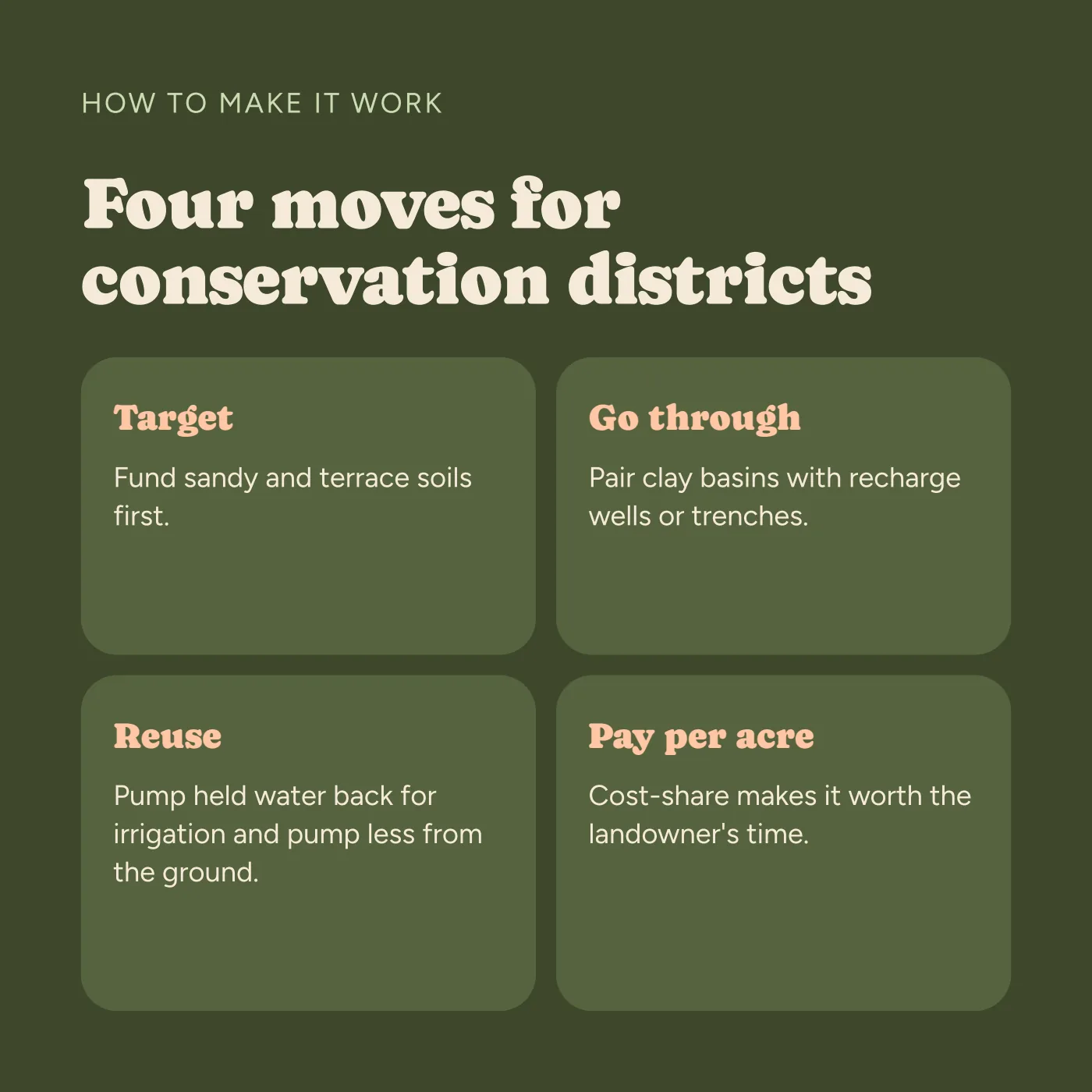
Where the ground is heavy, pair the basin with a recharge well or an infiltration trench that gets past the clay cap, or plan from the start to pump the water back out and use it. The carousel says this plainly and it is the right call.
Rice, pasture and grass handle standing water that corn and soybeans will not. A basin corner put into something that does not mind being wet has no drowning cost to contain.
Putting water underground is only half of what a basin is worth. The other half is pumping it straight back onto the crop, and that half is already a proven, funded practice with a name: tailwater recovery.
In the Lower Mississippi Alluvial Valley, farms catch runoff in a pit or a small on-farm reservoir and pump it back onto the field instead of pumping groundwater. Across forty-five monitored operations, surface water, tailwater recovery and on-farm storage together saved 11,069 acre-feet of groundwater. Getting that water back out and onto a crop has been costed at roughly $3.76 an acre-foot for the relift and application, which is cheap water by any measure.
The catch is what it costs to build. Whole tailwater recovery systems have run from about $400,000 to $900,000, which is why they are normally built with cost-share help. The United States Department of Agriculture's Natural Resources Conservation Service pays toward tailwater pits, irrigation reservoirs, pumping plants and the pipe between them through its Environmental Quality Incentives Program, and published a unit cost of $1.82 a cubic yard for a Delta tailwater pit in 2023.
The berm catches the rain, the lowest corner of the basin is dug out as a pit so there is somewhere for water to collect, a pump and a pipe move it back to the top of the field, and the cost-share covers most of the dirt work. The field gets watered from its own rain, the well gets a rest, and whatever soaks down on the way is a bonus rather than the whole business case.
In California, catching flood water on farmland and letting it soak has been costed at about $36 an acre-foot, against water costs for recharge ranging from $10 to $97 an acre-foot. That is the clearest published evidence that on-farm catching is cheaper than building reservoirs or dedicated recharge basins.
The berm follows the low side of the field, with a wide curve at the corner and no square ends, because the machinery has to cross it without slowing down. Field layout, headlands and turning rows all get planned around the shape rather than against it.
This is the biggest change and the one that does the most work. A tilled field seals over and sheds water; a long-term no-till field with cover crops drinks it. Without that change, a lot of basins just become ponds.
Filling basins on purpose is a winter and early-spring job, which means planning water around planting rather than the other way round, and accepting that a field with water on it in March is working rather than idle.
This is the one genuine environmental risk, and it is real. Pushing water down through a field that has nitrate left in it pushes the nitrate down too. Modelling of flood recharge on California farmland found it does add nitrate leaching, worst in dry conditions, though the volume of water involved can dilute it to around or below the drinking-water limit depending on soil and climate. In practice that means recharging when soil nitrate is at its lowest, and not doing it at all on a field that was heavily fertilised and not harvested.
The carousel ends on exactly the right question — would you shape your field if a cost-share covered the dirt work — because that is what decides whether this happens. The equipment is already on the farm. The willingness is the thing being bought.
One farm doing this changes nothing measurable. The unit that matters is a conservation district, an irrigation district or a whole river reach, which makes this an organising problem at least as much as an engineering one.
